Cook & Merge Kate's Adventure
- 4.7
- Rating
- 1.00M
- Installs
- Free
- Price

 Analysis by App-foxy
I spent time with Cook & Merge Kate's Adventure as a relaxed puzzle game rather than treating it like a quick level-based distraction. Its central idea is easy to understand: combine items, use them to prepare food, and help move a culinary story through a beachside town. That simple loop makes it approachable, but the real question is whether the routine stays enjoyable once the early novelty fades. In my experience, it works best for players who like gradual progress, light planning, and a game they can revisit in short sessions.
Developed by Supersolid, this free game sits in the puzzle category and is suitable for Everyone. It has built a strong audience, with over a million installs and a 4.7 average from around 32 thousand ratings. Those figures suggest that the basic formula connects with many players, but they do not remove the need to understand its rhythm. This is not a demanding logic game with difficult single-screen challenges. It is closer to a long-running merge-and-cooking journey, where the satisfaction comes from organizing a board, completing requests, and gradually seeing the adventure develop.
How the everyday gameplay loop feels
The baseline workflow is straightforward. I look at the current requests, check what ingredients or objects are available, merge matching pieces when it makes sense, and then use the resulting items for cooking-related tasks. The important part is not tapping as quickly as possible. It is deciding which pieces should be combined immediately and which should remain available because they may support another order soon.
You May Also Like

 Blood Strike: 2.5 Anniversary
Blood Strike’s Loadouts Turn Every Drop Into a Tactical Gamble
A close look at Blood Strike’s custom loadouts: how fast access to signature weapons reshapes its battle royale rhythm, rewards preparation, and narrows the gap between fights.

 Pandora - Music & Podcasts
Pandora’s Music Is Easy to Start, but Harder to Recover
Pandora’s strength is its low-effort path from a seed to a station. Its weak spot is how much confidence it asks you to place in connection, setup, and quiet recovery.

 8 Ball Pool
 Is Built on Rivalries, Rematches, and Routine
A close look at the rivalries, rematches, shared routines, and unanswered safety questions that turn a quick pool match into a persistent mobile community.

 Samsung Music
’s Quiet Strength Is Playing What You Already Own
Its reach comes less from spectacle than from dependable access to a personal library. That simplicity is both the app’s strongest retention engine and its ceiling.

 AccuWeather: Weather Radar
AccuWeather Review: A Quick, Clear Forecast for Everyday Decisions
For everyday plans, the best forecast is the one you can understand quickly. AccuWeather makes rain timing, radar, and local conditions easy to act on, with a few trade-offs.

 Hill Climb Racing
Why Hill Climb Racing Still Turns Crashes Into One More Run
A tiny car, a bumpy hill and one more upgrade: Hill Climb Racing keeps resurfacing because its simple chaos makes every near-miss feel personal.
More From Our News Desk



That small decision gives the game more texture than its short description suggests. A merge can clear space and create something useful, but it can also remove several lower-level items that would have helped with a different request. I learned to pause before combining the last few pieces of a type. When the board is crowded, keeping one or two basic items visible is often more useful than chasing the next upgrade without checking the current task list.
The cooking theme helps the loop feel more purposeful. Instead of merging objects with no context, I am working toward food-related goals and a journey through the town. The setting gives the progression a friendly sense of place, while the puzzle mechanics provide the hands-on activity. I would not call the narrative deep enough to carry the game by itself, but it gives each round a reason to continue and makes the routine feel less abstract than a plain matching board.
A realistic use case is a short break during a commute or while waiting for an appointment. I can open the game, inspect the available requests, make a few careful merges, and stop without needing to finish a long stage. That flexibility is one of its strongest qualities. It also means the game is easy to fit around daily life, although players who prefer uninterrupted, high-pressure sessions may find the pace too gentle.
What I check before making a merge
My first habit is to read the active requests before touching the board. This sounds obvious, but it prevents a common mistake: merging everything that can be merged simply because the larger item looks more valuable. The immediate visual improvement is satisfying, yet the board can become less flexible afterward. I try to identify the item that is currently closest to completion and then decide whether a merge helps that goal or merely creates a prettier board.
My second habit is to protect space. A crowded board makes every later decision harder, especially when several low-level pieces are waiting for their matching partners. I do not automatically combine items just to reduce clutter, because some combinations may consume the exact pieces needed for an order. Instead, I clear space when the result directly supports a request or opens a useful area for future drops.
The third habit is to treat requests as a priority system rather than a checklist to attack randomly. If one order needs items that are already close to completion, I usually handle it before starting a longer chain. This creates a more manageable board and gives the session a visible sense of progress. It also reduces the temptation to spend resources simply because the game offers a possible merge.
Players coming from traditional match-three games should adjust their expectations here. In a match-three title, the board usually rewards immediate combinations and chain reactions. In this game, the stronger choice is often slower: preserve options, watch the requests, and accept that an unfinished combination can be more valuable than a completed one. That difference is the main strategic adjustment for newcomers.
Settings and habits that make sessions smoother
There is no need to overcomplicate the setup. I recommend checking the device’s general sound and notification behavior before settling into the game. If I am playing during work or in a quiet room, reducing or muting audio at the device level keeps the experience unobtrusive. This is a practical adjustment rather than a gameplay trick, but it matters because the title is designed for repeated short visits.
I also pay attention to how much time I actually want to spend in one session. The game is free to download, with optional in-app purchases ranging from $0.49 to $124.99 per item. That wide range makes it especially important to decide in advance whether I am comfortable progressing at the free pace. I prefer to treat purchases as an optional convenience rather than part of the basic strategy. If a task feels slow, I first reorganize the board and return later instead of assuming that spending is the intended solution.
That approach is useful for families as well. The Everyone age rating makes the game broadly accessible, but younger players may still need guidance around optional purchases and the habit of repeatedly checking the shop or progression prompts. The puzzle itself is easy to explain; the more important lesson is learning to distinguish a genuine gameplay decision from an invitation to speed things up.
Another setting-related habit is to keep the game updated when possible. The current version is 0.77.10, and the minimum operating system requirement is Android 7.0. I would check compatibility before installing on an older device, especially if storage or system performance is limited. The game is not the right choice for someone who wants a completely offline, no-maintenance puzzle routine without checking how it behaves on their particular phone.
Faster patterns that do not sacrifice control
The quickest way I found to improve is not faster tapping; it is reducing unnecessary decisions. I scan the board in a consistent order, starting with the current requests, then the pieces that can be combined, and finally the empty spaces that could receive new items. Repeating that scan prevents me from bouncing around the screen and accidentally using a useful piece before I understand its role.
I also group similar pieces mentally before merging. When several possible combinations are visible, I choose the one that either completes a request or creates a helpful intermediate item. This is more reliable than always selecting the highest available merge. The larger result may be impressive, but if it does not serve a current goal, it can leave the board with fewer practical options.
A useful pattern is to finish one manageable request before spreading attention across several difficult ones. Completing an order can make the board easier to read and gives me a natural stopping point. I then reassess the remaining pieces instead of following the original plan rigidly. This matters because the board changes as items are combined, and a strategy that looked sensible a minute earlier may no longer be the best use of space.
I avoid playing while distracted when the board is especially full. The game is gentle, but crowded layouts punish careless taps. A short pause to identify the matching pieces is usually faster than recovering from an accidental merge or an awkward arrangement. For players who enjoy optimization, this is where the title becomes quietly engaging: the challenge is managing limited attention and board flexibility rather than solving a difficult mathematical puzzle.
There is also a useful stopping rule. If I have made the obvious merges and the next step would require several uncertain combinations, I leave the game and return later. Continuing out of habit can turn a calm puzzle into repetitive tapping. Because the game supports short visits naturally, stopping at a sensible point is part of playing well, not a sign that the session failed.
Where the system starts to feel limited
The same structure that makes the game accessible can also make it feel repetitive. The basic activities remain centered on merging, cooking-related requests, and progressing through the town. If you need constant mechanical variety, demanding logic problems, or a clear finish line, this may not hold your attention for long. Its appeal depends on enjoying incremental improvement and the small satisfaction of preparing the next useful item.
The free-to-play design is another consideration. I appreciate being able to start without an entry price, but the presence of purchasable items means the experience is not built around unlimited, frictionless progress. Players who dislike waiting, resource management, or any temptation to accelerate progress should approach carefully. Paying may make some moments more convenient, but it does not change the underlying style of play: the game still asks you to organize, merge, and repeat.
I would also avoid expecting the narrative to provide the same depth as a dedicated adventure game. The beachside town gives the cooking tasks a pleasant frame, yet the main reason to return is the puzzle loop. Someone looking for character-heavy storytelling, exploration, or a large collection of independent puzzles will probably be better served by a different genre. This title is strongest when the story is a light companion to the board rather than the main event.
On the other hand, players who enjoy traditional match-three games may find the slower planning refreshing. There are fewer moments of frantic reaction, and the value of a move can depend on what it preserves for later. Players who prefer pure merge games may appreciate the food theme and task structure, although they should know that the cooking presentation does not turn it into a detailed cooking simulator. The game uses cooking as the motivation for the puzzle loop, not as a replacement for it.
Who will get the most from the adventure
I would recommend it to someone who wants a friendly puzzle game that can be played in small pieces throughout the day. It suits players who like tidying a board, planning a few moves ahead, and watching a larger journey develop gradually. It is also a reasonable choice for a casual family device, provided adults establish clear boundaries around optional purchases.
It is less suitable for players who want every session to feel different, who dislike progression systems that encourage repeated visits, or who want a fully self-contained puzzle experience with no commercial pressure. If your ideal game is a difficult brainteaser where each level has one elegant solution, this will probably feel too open-ended and too routine. Likewise, if you want an action game with immediate feedback and high stakes, the relaxed pace may seem flat.
For experienced users, the best results come from combining three repeatable habits: inspect requests before merging, preserve basic pieces until their purpose is clear, and stop when the next move is uncertain. None of these habits makes the game radically different, but together they reduce wasted moves and make the board feel more controllable. That is the closest thing to mastery here: not finding a secret shortcut, but learning when patience creates more options than speed.
The game first appeared on October 5, 2022, and its current version shows that it remains an actively presented product rather than an abandoned experiment. I would still judge it by the play style rather than by age or popularity. A 4.7 average and roughly a thousand written reviews indicate a positive reception, but the right fit depends on whether you enjoy its particular balance of merge planning, food-themed tasks, and gradual town progression.
My final recommendation after settling into the routine
After playing it as intended, I see Cook & Merge Kate's Adventure as a comfortable, low-pressure puzzle game with enough planning to keep the basic loop from becoming mindless. Its best moments come from making a modest board decision that pays off several moves later, especially when a carefully preserved item completes a request or prevents the layout from becoming crowded.
Its weaknesses are equally clear. The pace can feel slow, the core actions repeat, and the optional purchase structure will not appeal to everyone. I would not choose it for intense challenge or deep storytelling. I would choose it for a quiet break, a few organized merges, and a gentle sense of progress that does not demand my full attention for an hour.
If you enjoy casual puzzle games and are happy to progress patiently, the free entry point makes it worth trying. My advice is to begin without spending, learn the request-and-board rhythm, and decide whether the routine itself is satisfying before considering any convenience purchase. The winning approach is controlled patience, not constant tapping. For the right player, that makes this beachside cooking adventure an easy game to keep nearby; for everyone else, a more varied or more challenging puzzle title will be a better use of time.
FAQs for Cook & Merge Kate's Adventure
01What is Cook & Merge Kate’s Adventure?
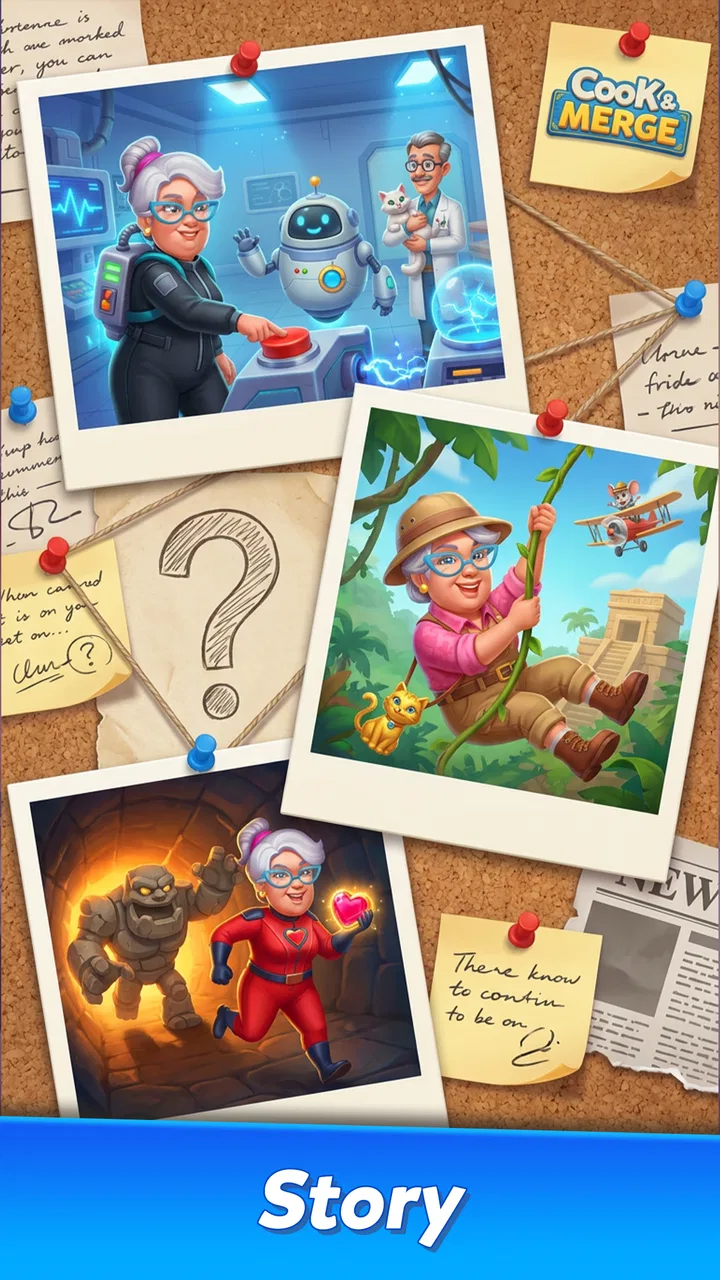
Cook & Merge Kate’s Adventure is a casual cooking and merge game in which you combine matching ingredients and kitchen items to complete recipes, serve customers, and help Kate restore and improve different locations. Alongside the cooking challenges, the game includes a light adventure and renovation storyline, giving your progress a purpose beyond simply completing levels.
02How do you play Cook & Merge Kate’s Adventure?
The main gameplay revolves around merging identical items to create upgraded ingredients, tools, or dishes. You use the items produced on the board to fulfill orders and advance through the story. As you progress, new recipes, characters, areas, and objectives become available. The controls are simple, but planning your merges carefully is important because board space and available energy can limit your options.
03Is Cook & Merge Kate’s Adventure free to download and play?
Cook & Merge Kate’s Adventure can generally be downloaded for free, but it may include optional in-app purchases. These purchases can provide extra energy, boosters, coins, or other resources that help you progress more quickly. The game is designed to be playable without spending money, although free players may need to wait for energy to recharge or complete activities more gradually.
04Does Cook & Merge Kate’s Adventure require an internet connection?
An internet connection may be required for some features of Cook & Merge Kate’s Adventure, including synchronizing progress, loading advertisements, processing purchases, receiving events, and accessing online services. Certain gameplay sections might work temporarily offline, but this can vary by device and version. For the most reliable experience, it is best to launch and play the game while connected to Wi-Fi or mobile data.
05Is Cook & Merge Kate’s Adventure suitable for all ages?
Cook & Merge Kate’s Adventure is generally suitable for players who enjoy relaxed puzzle, cooking, and story-based games. Its mechanics are easy to understand, making it accessible to younger and casual players, while the merge strategy offers some decision-making for adults. Parents should still review the store rating, advertising, chat or social features if available, and in-app purchase settings before allowing children to play.
Pros
- Relaxing merge puzzles are easy to learn and suitable for short sessions.
- The cooking theme gives familiar objectives a charming
- approachable feel.
- New recipes and locations provide a steady sense of progression.
- Bright visuals and character animations make the game pleasant to browse.
- Optional boosters can help when a puzzle board becomes difficult.
Cons
- Energy limits may interrupt play when you want longer uninterrupted sessions.
- Some upgrades and recipe goals require repeated merging and grinding.
- Later levels can feel more dependent on boosters or lucky item drops.
- Frequent rewards and pop-ups may make the interface feel busy.
- Progress can be slower without spending premium currency or watching ads.

Cook & Merge Kate's Adventure
Gallery